
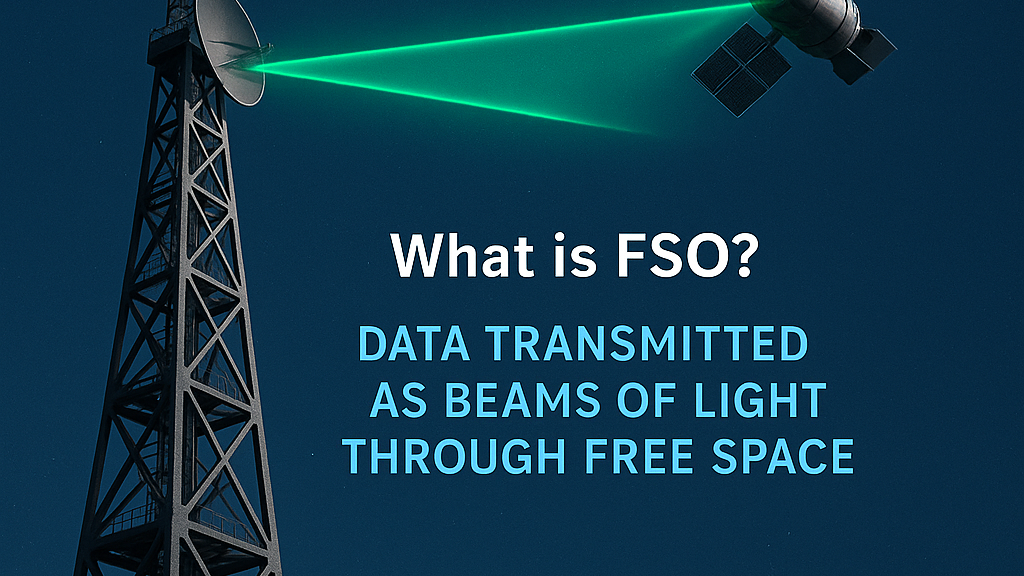
Wireless Lasers: The Future Beyond Radio Communication
When we thought we had reached the pinnacle of radio communication, a new breakthrough emerged which doesn’t rely on traditional cables or crowded radio frequencies. This innovation is called Free-Space Optical (FSO) communication, often nicknamed “wireless fiber.” Instead of using radio waves, FSO transmits data through focused beams of light traveling directly through the air.
How It Works: The Magic of Light
At its core, FSO is elegantly simple. The system has two main parts: a transmitter and a receiver. The transmitter converts data into a tightly focused, invisible laser beam. The receiver, positioned in direct line of sight, captures the beam and instantly converts it back into usable electrical signals.
Unlike Wi-Fi or Bluetooth, which scatter signals in all directions, FSO is laser-focused like literally. Think of it like a laser pointer, except instead of a red dot, it’s carrying entire libraries of data in fractions of a second.
Real-World Applications
FSO is no longer just an experimental concept but a critical system today:
- Maritime and Coastal Connectivity (Saudi Arabia) :
KAUST and Taara (by X) successfully established an FSO link delivering 20 Gbps between KAUST’s shore station and Umm-Misk Island (~2 km away). This marks the first deployment of Taara’s FSO system in the Kingdom, enabling high-speed maritime connectivity where fixed infrastructure is absent.
KAUST and Taara (by X) successfully established an FSO link delivering 20 Gbps between KAUST’s shore station and Umm-Misk Island (~2 km away). This marks the first deployment of Taara’s FSO system in the Kingdom, enabling high-speed maritime connectivity where fixed infrastructure is absent.
- Rural Broadband (Malaysia) :
Telekom Malaysia is deploying FSO in remote locations like Pulau Bum Bum, offering up to 3 km wireless data links to deliver internet where traditional towers or cables aren’t feasible.
- Military & Tactical Communications (Japan, USA) :
The U.S. Marines conducted field testing of mobile, ground-to-ground FSO systems at Camp Hansen, Okinawa in 2018 is designed for secure, tactical laser communication, with potential future use for ship-to-shore or air-to-ground links.
- Military Satellite Communications (Netherlands) :
The Netherlands’ military, via FSO Instruments and its consortium, plans to launch the PAMI-1 satellite (2027). This satellite will demonstrate laser communications for secure, high-speed data transfer between satellite and ground stations.
These examples show how FSO is already shaping the future of global communications, both on Earth and in space.
Big Wins: Why Wireless Lasers Matter
Blazing Speeds: Gigabit to multi-gigabit capacity, rivaling fiber.
Ironclad Security: Narrow beams are exceptionally difficult to intercept.
Rapid, Cost-Efficient Deployment: No trenching or wiring needed.
Resilient to Interference: Immune to RF noise and electromagnetic interference.
Hurdles: Taming Mother Nature
Of course, the technology isn’t without challenges. Weather conditions like fog, rain, or atmospheric turbulence can scatter and weaken laser signals just like trying to shine a laser pointer through mist. To overcome this, engineers are building hybrid RF/FSO systems that can switch to radio waves during poor weather, ensuring uninterrupted communication.
The commercial viability of this approach lies in its superior cost-effectiveness compared to laying new fiber. It bypasses the extensive time and expense of civil works, making deployment significantly faster and often 2 to 5 times cheaper. The value of being able to install a multi-gigabit link in days, rather than waiting months or years, is a massive commercial advantage that justifies the upfront cost of the hybrid setup.
The Future Looks Bright
FSO might just be the technology that breaks our dependence on physical cables and takes wireless communication into an entirely new era one defined by flexibility, speed, and security. While the journey to mainstream adoption is still unfolding, one thing is certain: the future of communication isn’t just wireless, it’s laser-powered.
Given FSO’s speed and security benefits, what industries do you think will be the next to adopt this technology on a large scale? Could we eventually see a world where physical fiber optic cables are used only for long-haul networks, with wireless lasers handling the last-mile connections?